Course Overview
Our Object Oriented Programming course, offered by the University of Latvia, has several shortcomings that need to be addressed. The course material is outdated, the examples used are not relevant to current industry practices, and the assignments do not effectively reinforce the concepts taught in lectures. Additionally, the course lacks sufficient hands-on projects that would help students gain practical experience.
If you'd like to experience the joy of this OOP course we have watchparties
First Week: A Rocky Start
The first week of our Object Oriented Programming course was cancelled, which set a negative tone for the rest of the semester. This unexpected cancellation caused confusion and disrupted our learning schedule, making it difficult to catch up on the missed material.
Second Week: Technical Troubles
The second week of our Object Oriented Programming course was equally frustrating. We spent two hours watching an Ubuntu installation screen with frequent breaks every 20 minutes. This was not an effective use of our time, and many students encountered errors and problems during the installation process. Approximately 70% of the students faced issues, and we had to persuade the instructor to cancel some graded assignments due to these widespread problems.
I have to note that what the previous writer just told you about was described in the course description as the task for 04.02.2025 @odo. However, the instructions given back then differed from what he was showing on screen. Referring back to his documentation, it could be now seen that he has TWO different instructions on setting up the work environment with differences along the way -- in one of them, the main work repo was downloaded as a .zip file, in the other -- it was cloned from his given link.
Some of the parts of his tutorials were straight-up not possible to do anymore -- like modifying the /etc/apt/sources.list file which is no longer present on Xubuntu 24.04, his recommended system -- or even malicious -- like removing the update-manager and the snap package manager. One of the students noted that their Firefox installation was gone after they deleted snap. Tough luck.
Also, the teacher spent about 5 minutes of our time explaining that Linux is much more superior compared to Windows. Refer to the time code 13:13 of the first lecture here. This will become relevant on the 5th week. Someone should backup his recordings in case they get deleted... // done
During the second week, we spent 3 hours installing Xubuntu on virtual machines. The reason for this was that the instructor's automated tests and unit tests rely on GNU core utilities, which are primarily available on GNU/Linux systems. This incompatibility with Windows and macOS systems necessitated the use of Xubuntu.
Third Week: IDE Confusion
The third week started with the teacher continuing to explain how to set up the work environment, including downloading the JDK and Maven packages, setting up the cloned project, and demonstrating how to work in it. Despite the instructions advising the use of Eclipse IDE, the teacher used IntelliJ IDEA because he "prefers it," which confused many students who followed the original instructions.
When showing how to get IntelliJ IDEA, the teacher downloaded the .tar.gz archive and installed the program using this method. Using the command to install it with snap was not an option, considering that the snap package manager should be removed. When the teacher attempted to show the Eclipse IDE, he realized that the JUnit tests did not run. Instead of providing a proper solution, he demonstrated how to run the tests using the terminal, leaving Eclipse users in a difficult position.
For the next 30 minutes, the teacher struggled to launch the projects with both IDEs. Eventually, he decided to show us how to connect to his SSH server. The passwords to the SSH server were provided in a format that included the student's ID, which meant that if someone had another student's ID number, they could easily log in and change the password, causing issues for the affected student.
Fourth Week: Questionable Responses
The fourth week was quite uneventful in terms of lecture content, but the responses to our questions were quite memorable. The instructor's replies included statements like "luck favors the strong," "only a fool thinks that plans can be implemented without any adjustments," "But in general it is considered bad programmer, who can't manage to get decent hardware for her/him-self," and "Please clarify your question, otherwise it just looks like hallucinated garbage." These responses left many of us feeling frustrated and disrespected.
Fifth Week: Testing Turmoil
1st Lecture: ChatGPT in Action
Nothing of note in particular, except for the fact that the teacher decided to use ChatGPT to generate code for activity04, which is needed to complete activity05. Refer to the time code 45:23 of the fourth lecture here.
2nd Lecture: The Test Debacle
What a disaster...
Test Format: A Messy Affair
The test took place on his odo platform and not E-Studijas, which has relatively decent test options. The test page itself consisted of two fields for the student identifier and all the answers, and a submit button.
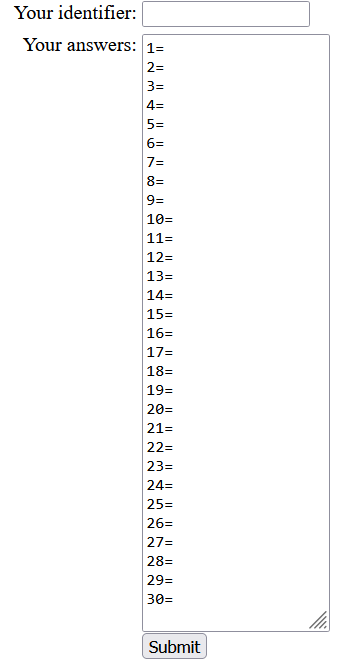
The answers had to be in the exact format "2=a" otherwise you got 0 points for the question. The questions themselves were provided as a non-copyable PDF file, so basically an image. Also, he basically answered the first 3 questions at the start of the lecture, so you could just copy-paste them.
Test Questions: A Mixed Bag
Not all tests are created equal. Some questions were actually about the course material or Java, even though they were written in broken English. Some questions were unrelated to OOP, such as his server IP address, his git repository, and so on. And then there were questions 20 and 21.
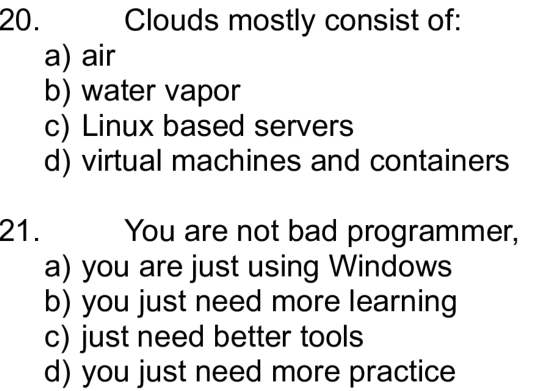
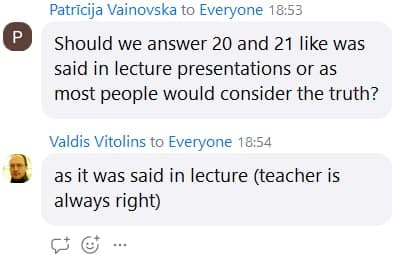
One could argue that all answers are correct, but no, as V.V. said -- "teacher is always right," and in this case, the correct answers for question 20 is (c) and for question 21 is (a) as was mentioned in the first lecture.
Post-test Review: More Confusion
After the test ended, he went through all the questions and wasted even more time (approximately 30 minutes) on saying the correct answers to all of the questions. He tried to copy-paste and compile question 30 three times, failed to do so, said that it should have compiled and the correct answer to question 3 is (c), failed to elaborate, and ended the lecture 30 minutes early.
Sixth Week: Attendance Drop and Bizarre Tasks
The attendance dropped from approximately 100 students to 38. We were also assigned a bizarre
task
where we had to implement classes with methods like vomit() and
killHimself(). I wonder if LU even allows this by law.
Ongoing Concerns
The course is not over yet, and we are increasingly concerned about the quality of the remaining lectures and assignments. This course is mandatory, and its current state is causing significant stress and frustration among students. We hope that the issues will be addressed promptly to ensure a better learning experience for everyone involved.
To add some humor to the situation, we created bingo cards for weeks 4-6 of the course. These bingo cards highlight some of the most memorable and bizarre moments from the lectures. You can check them out here.
For more information on OOP courses and reviews, you can visit the following resources: